> ## Documentation Index
> Fetch the complete documentation index at: https://docs.fintoc.com/llms.txt
> Use this file to discover all available pages before exploring further.
# Receiving transfers
> Receive inbound transfers in real time on Fintoc's legacy v2023-11-15 Transfers API and reconcile payments against orders, invoices, or user accounts.
# 🇲🇽 Inbound transfers in Mexico
Receive and reconcile inbound transfers through Fintoc's Transfers API. Complete the setup guide before following these steps:
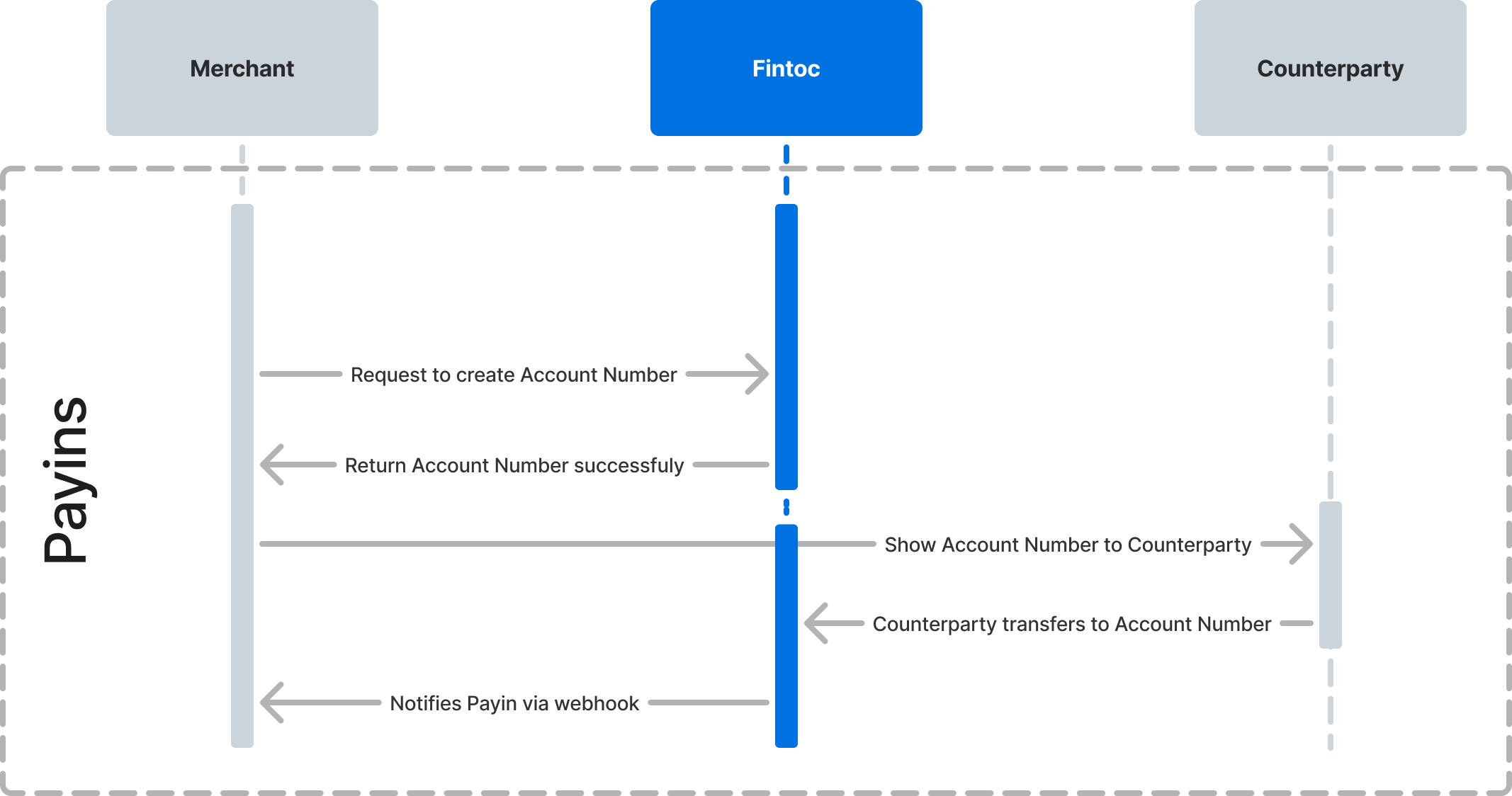
1. Find or create an `AccountNumber` using your **Secret key**. This object represents a standardized Mexican bank account number ([CLABE](https://es.wikipedia.org/wiki/CLABE)) for the Interbank Electronic Payment System (SPEI). When you sign in to the dashboard, you start with one **Default Account Number**.
2. Create a `WebhookEndpoint` to handle inbound transfer events.
3. Receive a transfer at the `AccountNumber` and get notified in real time.
The following diagram shows how Fintoc interacts with you and the counterparty that sends the inbound transfer.
## Step 1: Create an account number (SPEI CLABE)
An `AccountNumber` represents a SPEI CLABE. Assign an account number to a customer or order to reconcile inbound transfers with your records. For example, you can assign one account number to each customer to identify which customer sent a transfer. To learn more about account numbers, see the [data model](/v2023-11-15/guides/transfers/transfers-overview/v2-transfers-account-number-data-model).
### Attach metadata to your account number
When you create an account number, attach key-value data through `metadata`. For example, store your internal customer ID to associate the account number with a customer. Fintoc includes the metadata in each inbound transfer so you can reconcile the transfer with your records.
### Example
Use your test **Secret Key** and **Account ID** to create an `AccountNumber` from your backend. Attach the internal customer ID as `id_cliente`:
```bash theme={null}
curl --request POST \
--url https://api.fintoc.com/v2/account_numbers \
--header 'Authorization: sk_test_9c8d8CeyBTx1VcJzuDgpm4H' \
--header 'accept: application/json' \
--header 'content-type: application/json' \
--data '
{
"account_id": "acc_Lq7dP901xZgA2B",
"metadata": {
"id_cliente": "12343212"
}
}
'
```
The response should look like this:
```json theme={null}
{
"id": "acno_Kasf91034gj1AD",
"object": "account_number",
"description": "My payins",
"number": "000000000000000000",
"account_id": "acc_Lq7dP901xZgA2B",
"created_at": "2024-03-01T20:09:42.949787176Z",
"mode": "test",
"metadata": {
"id_cliente": "12343212"
}
}
```
### Use an SDK
Use the Fintoc Python or Node SDK to create the account number:
```python Python theme={null}
account_number = client.v2.account_numbers.create(
account_id="acc_M8sKf230BgHjD4",
metadata={"id_cliente": "12343212"}
)
```
```javascript Node theme={null}
const accountNumber = await fintoc.v2.accountNumbers.create({
account_id: 'acc_M8sKf230BgHjD4',
metadata: {
'id_cliente': '1234324',
},
});
```
## Step 2: Create a webhook endpoint to handle inbound transfer events
When you receive an inbound transfer, Fintoc sends a `transfer.inbound.succeeded` event. Follow the [webhook guide](/v2023-11-15/guides/resources/webhooks-walkthrough) to create a webhook endpoint that receives and processes these events.
The `transfer.inbound.succeeded` event looks like this:
```json json theme={null}
{
"id": "evt_a4xK32BanKWYn",
"type": "transfer.inbound.succeeded",
"object": "event",
"data": {
"id": "tr_jKaHD105H",
"object": "transfer",
"direction": "inbound",
"status": "succeeded",
"amount": 2864,
"currency": "MXN",
"mode": "test",
"post_date": "2020-04-17T00:00:00.000Z",
"transaction_date": "2020-04-17T05:12:41.462Z",
"comment": "Electricity bill",
"reference_id": "130824",
"receipt_url": "https://www.banxico.org.mx/cep/",
"tracking_key": "s2123423423324334",
"return_reason": null,
"account_number": {
"id": "acno_Kasf91034gj1AD",
"object": "account_number",
"account_id": "acc_Jas92lf9adg94ka",
"description": "My payins",
"number": "000000000000000000",
"created_at": "2024-03-01T20:09:42.949787176Z",
"mode": "test",
"metadata": {
"client_id": "12343212"
}
},
"counterparty": {
"holder_id": "AAAA010101AAA",
"holder_name": "Test Customer 1",
"account_number": "000000000000000000",
"type": "clabe",
"institution": {
"id": "40012",
"name": "BBVA Mexico",
"country": "mx"
}
}
},
"created_at": "2020-04-22T21:10:19.254Z",
"mode": "test"
}
```
## Step 3: Receive a transfer at your account number
After you create an account number and webhook endpoint, send a transfer to the account number. Use the resulting webhook event to reconcile the payment.
To test this flow in `test` mode, use the `/simulate/receive_transfer` endpoint to simulate an inbound transfer. The simulation follows the same flow as a real transfer to the specified account number. See the [test guide](/v2023-11-15/guides/transfers/test-your-integration) for simulation instructions.
# 🇨🇱 Inbound transfers in Chile
Receive and reconcile inbound transfers through Fintoc's Transfers API. Complete the setup guide before following these steps:
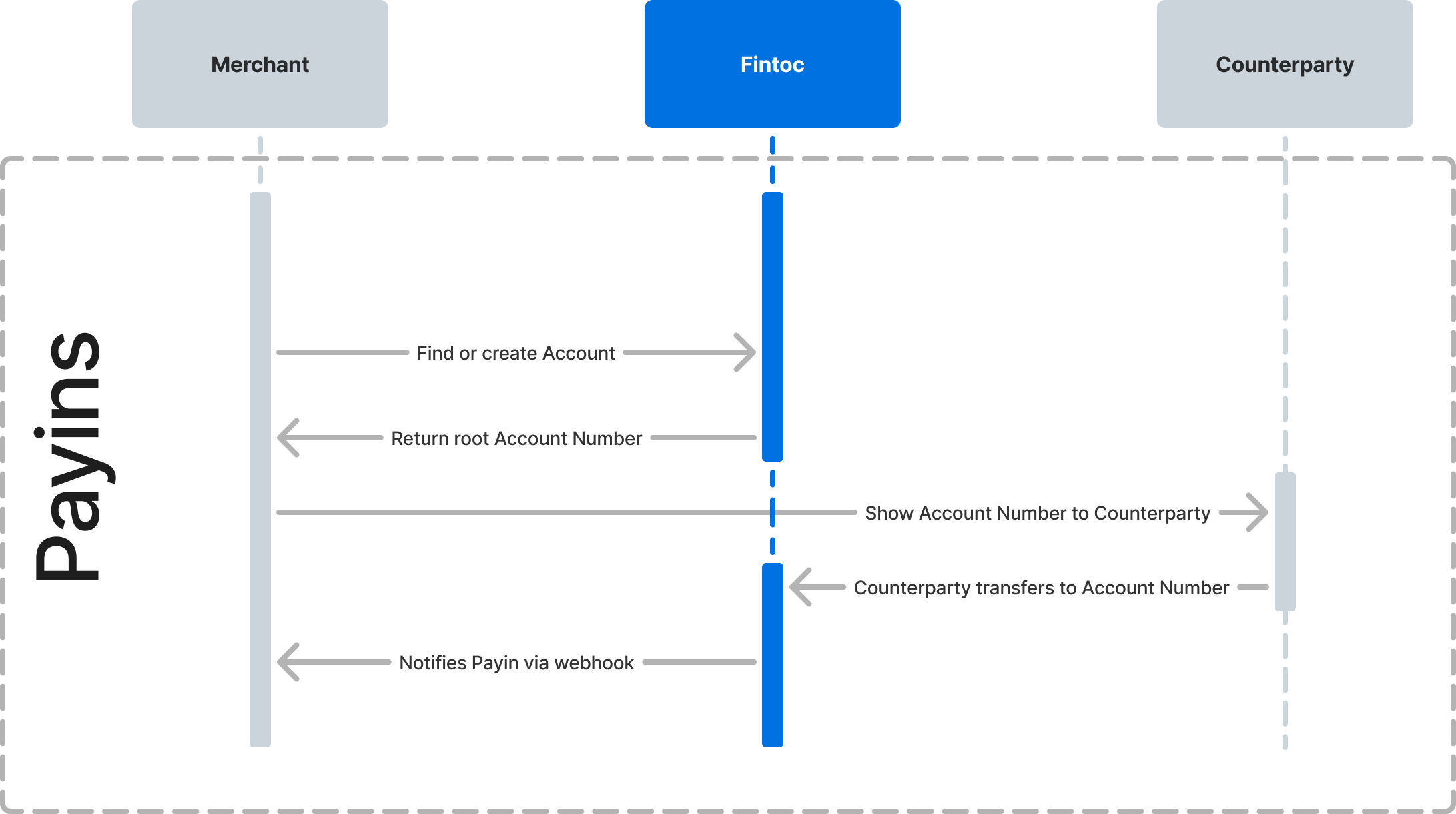
1. Create a `WebhookEndpoint` to handle inbound transfer events.
2. Receive a transfer in your `Account` and get notified in real time.
The following diagram shows how Fintoc interacts with you and the counterparty that sends the inbound transfer.
 ## Step 1: Create a webhook endpoint to handle inbound transfer events
When you receive an inbound transfer, Fintoc sends a `transfer.inbound.succeeded` event. Follow the [webhook guide](/v2023-11-15/guides/resources/webhooks-walkthrough) to create a webhook endpoint that receives and processes these events.
The `transfer.inbound.succeeded` event looks like this:
```json json theme={null}
{
"id": "evt_a4xK32BanKWYn",
"type": "transfer.inbound.succeeded",
"object": "event",
"data": {
"id": "tr_jKaHD105H",
"object": "transfer",
"direction": "inbound",
"status": "succeeded",
"amount": 2864,
"currency": "CLP",
"mode": "test",
"post_date": "2020-04-17T00:00:00.000Z",
"transaction_date": "2020-04-17T05:12:41.462Z",
"comment": "Electricity bill",
"reference_id": null,
"receipt_url": null,
"tracking_key": null,
"return_reason": null,
"account_number": {
"id": "acno_Kasf91034gj1AD",
"object": "account_number",
"account_id": "acc_Jas92lf9adg94ka",
"description": "My payins",
"number": "000000000000000000",
"created_at": "2024-03-01T20:09:42.949787176Z",
"mode": "test",
"metadata": {
"client_id": "12343212"
}
},
"counterparty": {
"holder_id": "00000000T",
"holder_name": "Test Customer 1",
"account_number": "000000000000000000",
"type": "checking_account",
"code": "01",
"institution": {
"id": "cl_banco_santander",
"name": "Banco Santander",
"country": "cl"
}
}
},
"created_at": "2020-04-22T21:10:19.254Z",
"mode": "test"
}
```
## Step 2: Receive a transfer at your account number
After you identify your `Account` and its `root_account_number`, add a webhook endpoint for notifications. Send a transfer to the account number, then use the resulting webhook event to reconcile the payment.
To test this flow in `test` mode, use the `/simulate/receive_transfer` endpoint to simulate an inbound transfer. The simulation follows the same flow as a real transfer to the specified account number. See the [test guide](/v2023-11-15/guides/transfers/test-your-integration) for simulation instructions.
## Step 1: Create a webhook endpoint to handle inbound transfer events
When you receive an inbound transfer, Fintoc sends a `transfer.inbound.succeeded` event. Follow the [webhook guide](/v2023-11-15/guides/resources/webhooks-walkthrough) to create a webhook endpoint that receives and processes these events.
The `transfer.inbound.succeeded` event looks like this:
```json json theme={null}
{
"id": "evt_a4xK32BanKWYn",
"type": "transfer.inbound.succeeded",
"object": "event",
"data": {
"id": "tr_jKaHD105H",
"object": "transfer",
"direction": "inbound",
"status": "succeeded",
"amount": 2864,
"currency": "CLP",
"mode": "test",
"post_date": "2020-04-17T00:00:00.000Z",
"transaction_date": "2020-04-17T05:12:41.462Z",
"comment": "Electricity bill",
"reference_id": null,
"receipt_url": null,
"tracking_key": null,
"return_reason": null,
"account_number": {
"id": "acno_Kasf91034gj1AD",
"object": "account_number",
"account_id": "acc_Jas92lf9adg94ka",
"description": "My payins",
"number": "000000000000000000",
"created_at": "2024-03-01T20:09:42.949787176Z",
"mode": "test",
"metadata": {
"client_id": "12343212"
}
},
"counterparty": {
"holder_id": "00000000T",
"holder_name": "Test Customer 1",
"account_number": "000000000000000000",
"type": "checking_account",
"code": "01",
"institution": {
"id": "cl_banco_santander",
"name": "Banco Santander",
"country": "cl"
}
}
},
"created_at": "2020-04-22T21:10:19.254Z",
"mode": "test"
}
```
## Step 2: Receive a transfer at your account number
After you identify your `Account` and its `root_account_number`, add a webhook endpoint for notifications. Send a transfer to the account number, then use the resulting webhook event to reconcile the payment.
To test this flow in `test` mode, use the `/simulate/receive_transfer` endpoint to simulate an inbound transfer. The simulation follows the same flow as a real transfer to the specified account number. See the [test guide](/v2023-11-15/guides/transfers/test-your-integration) for simulation instructions.